Single vs Double Girder Overhead Crane: The Complete Comparison Guide
Choosing between a single girder and a double girder overhead crane is a critical decision that impacts your budget, workflow, and building requirements. This guide breaks down the key differences in load capacity, span, cost, and ideal applications to help you make a straightforward, informed choice.
What Are Single and Double Girder Overhead Cranes?
An
overhead crane is a material handling system that moves on rails mounted to a building’s ceiling or support structure. A hoist travels across a horizontal beam (the girder) to lift and move heavy loads efficiently, saving valuable floor space.
The Core Difference: Girder Count
The fundamental difference lies in the number of primary support beams:
Single Girder Crane: Utilizes
one main beam. The hoist is suspended and operates underneath this single girder.
Double Girder Crane: Utilizes
two parallel main beams. The hoist runs on top of or between these two girders.
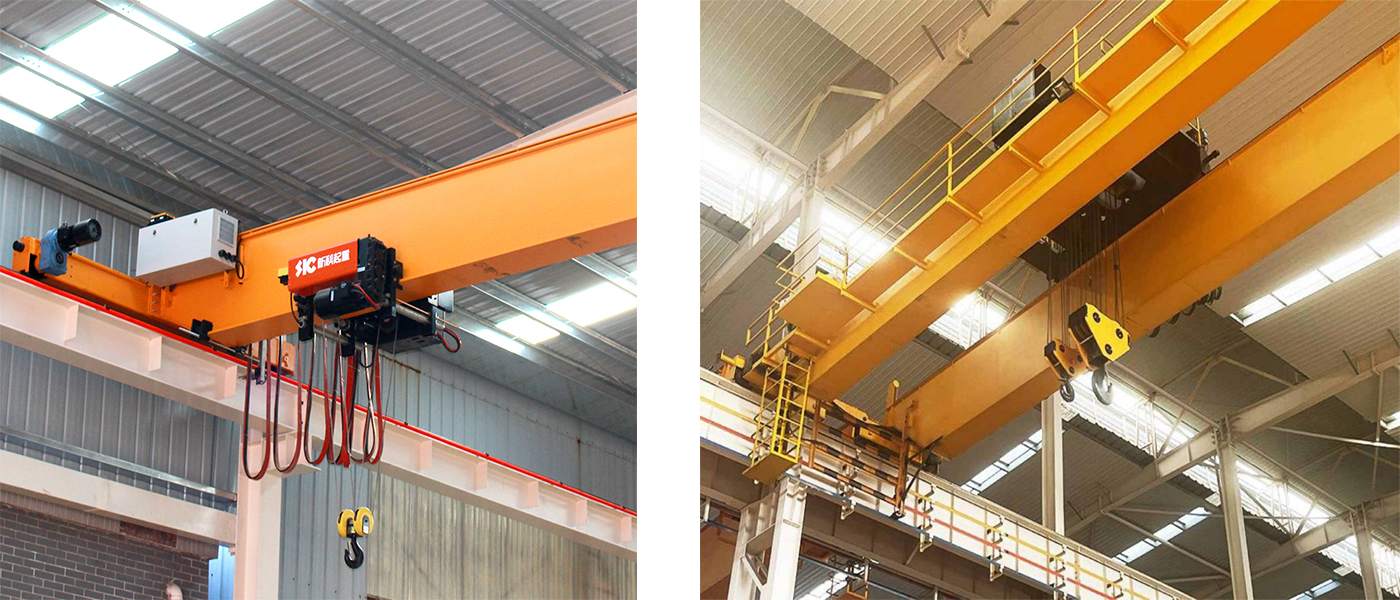
Both types perform the same basic function, but the number of girders leads to significant differences in capability, cost, and application.
Key Differences: Single vs. Double Girder Cranes
1. Lifting Capacity
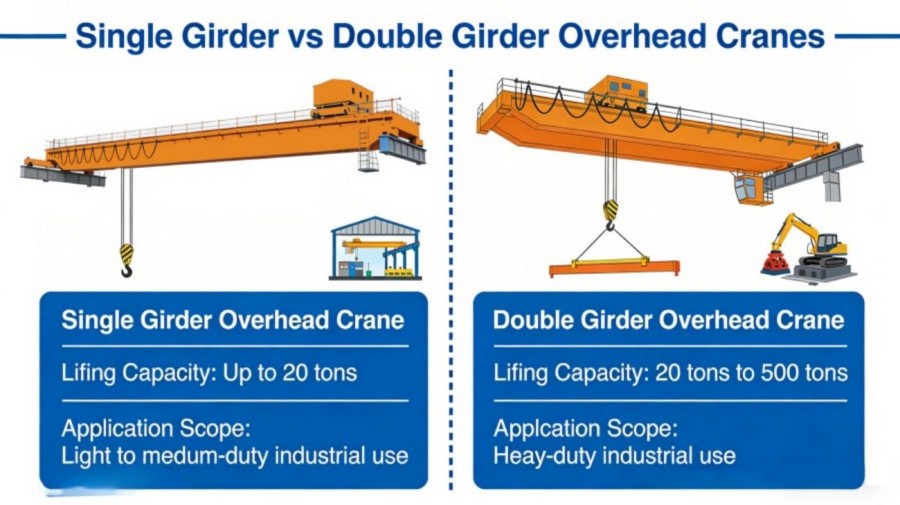
This is the most decisive factor. The 5 to 20-ton range is the overlap zone where either type couldbe an option.
crane type
| Typical Capacity Range | Best For |
| Single Girder | ½ ton to 20 tons | Everyday jobs: machine parts, pallets, engines, manufacturing components. |
| Double Girder | 5 tons to 100+ tons | Heavy industry: steel coils, large machinery, ship parts, massive industrial loads. |
Simple Rule: Needs under 5 tons? Choose Single Girder. Needs over 20 tons? You need Double Girder.
2. Span (Reach Distance)
Span is the distance between the crane’s runway rails. Wider spans reduce lifting capacity due to beam deflection. Double girder cranes handle long spans much more effectively.
| Span Requirement | Single Girder Performance | Double Girder Performance |
| Up to 40 ft | Works great. | Often overkill. |
| 40 – 60 ft | Functional, but capacity drops. | A good choice. |
| 60 – 100 ft | Tricky; significant capacity loss. | Handles it well. |
| Over 100 ft | Usually not possible. | Typically required. |
3. Cost Comparison
Upfront Cost: For equivalent capacity, a double girder crane costs 40-50% more than a single girder crane.
Installation Cost: Single girder installation is typically 20-30% cheaper and faster, requiring minimal building reinforcement. Double girder cranes are heavier, need stronger support, and incur higher installation and potential building modification costs.
Quick Cost Reference:
Best Applications for Each Type
When to Choose a Single Girder Crane (90% of General Use)
Ideal for lighter, more frequent tasks in standard industrial settings.
Manufacturing & Assembly: Moving parts between machines, assembly line feeding.
Warehousing & Distribution: Handling pallets and most stored goods.
Construction Sites: Temporary setups where easy transport and quick installation are key.
Automotive Shops: Lifting engines, transmissions, and for repair work.
When to Choose a Double Girder Crane (Heavy Industrial Duty)
Necessary for extreme loads, long spans, or precision heavy lifting.
Steel Mills & Fabrication Plants: Handling massive steel coils and sections.
Foundries & Heavy Equipment Manufacturing.
Precast Concrete Plants.
Any application requiring lifts over 20 tons or spans over 60 feet.
Pros and Cons at a Glance
Single Girder Pros: Lower cost (40-50%), cheaper/faster installation, less building strain, simpler maintenance.
Single Girder Cons: Lower capacity (max ~20 tons), shorter max span, more beam deflection, less headroom.
Double Girder Pros: Higher capacity (100+ tons), superior long-span performance, less deflection for precision, more headroom, extreme stability.
Double Girder Cons: Higher cost (40-50%), more complex/expensive installation, needs robust building support, overkill for most uses.
The Bottom Line: Choose single girder if it meets your needs. Choose double girder only if single girder cannotdo the job.
5-Step Decision Framework
Follow this simple process to determine the right crane for your facility.
Confirm Your Heaviest Load: Add a 25% safety margin. <20 tons = consider single. ≥20 tons = need double.
Measure Your Required Span: Distance between runway rails. ≤40 ft favors single; ≥60 ft strongly favors double.
Evaluate Your Building Structure: Have a structural engineer assess it. Double girders demand significantly stronger support.
Set a Realistic Total Budget: Include crane, installation, reinforcement, electrical, and maintenance. Single girder total cost is 30-50% lower.
Assess Your Usage Frequency: Light/occasional use favors single. 24/7 heavy-duty use may justify the durability of a double.
Quick Decision Guide (Checklist)
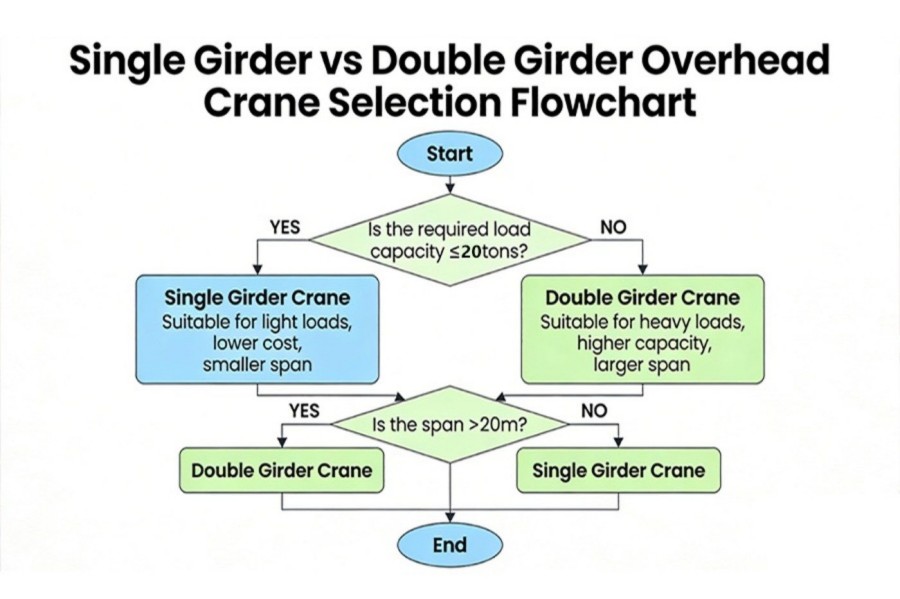
Choose a Single Girder Overhead Crane if:
✓ Your heaviest load is under 20 tons.
✓ Your required span is under 60-80 feet.
✓ Budget is a primary concern.
✓ Your building is a standard, not heavy-duty, structure.
✓ You’re in general manufacturing, warehousing, or assembly.
Choose a Double Girder Overhead Crane if:
✓ You need to lift loads over 20 tons.
✓ You need a span over 60-80 feet.
✓ You work in heavy industry (steel, foundries).
✓ You require precision positioning of heavy loads.
✓ Your building is structurally heavy-duty.
Final Checklist & Buying Tips
Before you commit, ensure you have:
[ ] Calculated max load + safety margin.
[ ] Measured the exact span.
[ ] Completed a professional building evaluation.
[ ] Gotten detailed quotes for both crane types.
[ ] Understood the total installed cost and maintenance needs.
Smart Buying Tips:
Get “apples-to-apples” quotes with the same specs.
Always ask for the total installed cost.
Verify warranty, parts availability, and installer credentials.
Request references from similar installations.
Red Flags to Avoid:
Sellers who give vague quotes, push unnecessary capacity, ignore building requirements, or offer prices that seem too good to be true.